
Best Case Interview Books: 18 Books Ranked (2026)
Author: Taylor Warfield, Former Bain Manager and interviewer
Last Updated: June 16, 2026
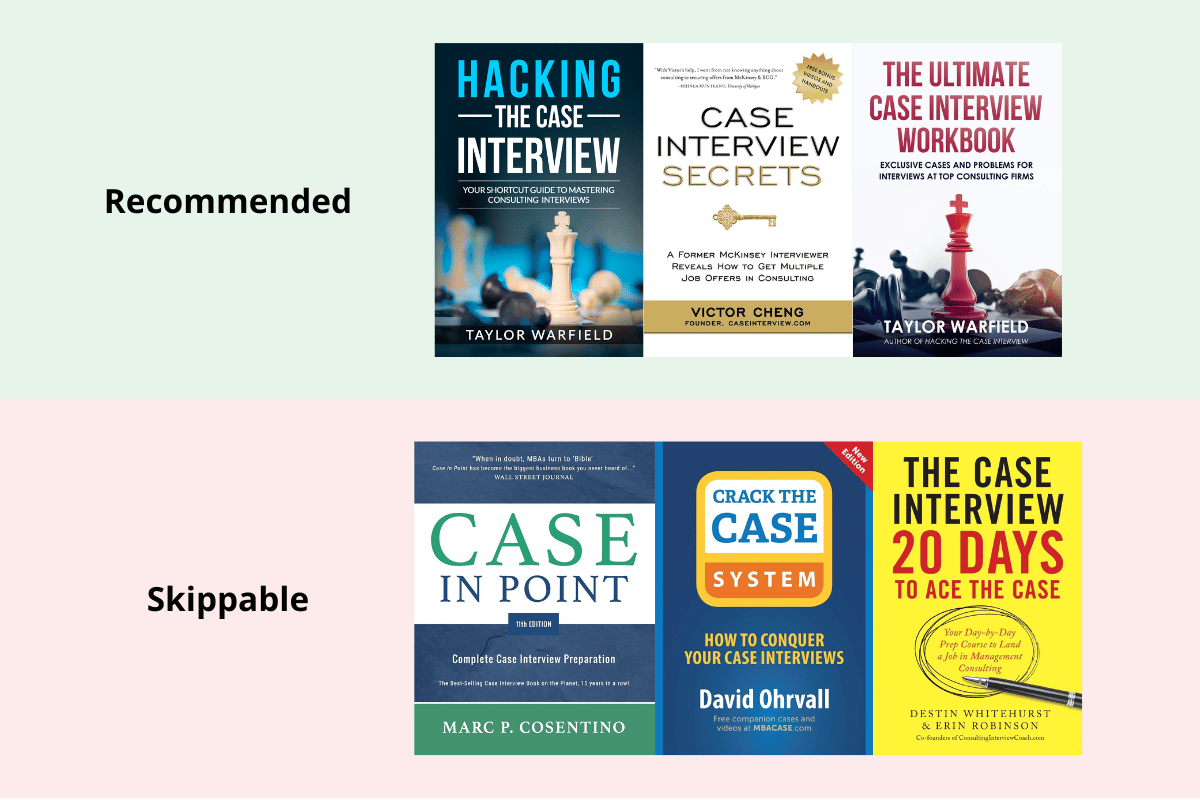
Case interview books vary widely in quality, and after reading all 18 books on the market, I found that only 5 teach strategies that actually work in modern consulting interviews. Below, I rank every book, explain exactly which ones to read and which to skip, and share 700+ free practice cases from MBA casebooks that most candidates never discover.
Before reading on:
Most candidates struggle to land interviews and even fewer turn them into offers. Watch my free training to learn how to triple your chances of landing interviews and increase your chances of receiving an offer by 8x.
Key Takeaways
The best case interview books are Hacking the Case Interview for learning modern strategies, The Ultimate Case Interview Workbook for targeted drills and full-length cases, and Case Interview Secrets for understanding interviewer psychology.
- Read 2 to 3 books maximum: one strategy book and one practice book cover everything you need
- Hacking the Case Interview ranks #1 because it teaches custom frameworks instead of memorized templates
- Skip Case in Point: interviewers penalize the rigid, memorized frameworks it teaches
- Free MBA casebooks give you 700+ practice cases without spending a dollar
- Books teach you strategy, but you still need live practice cases and drills before interview day
What Changed in 2026?
I re-tested every ranking in this guide against the current editions of all 18 books and updated each review where the content has changed. The free casebook library now includes the latest editions from Wharton, Booth, Darden, Bauer, and ESADE. I also added a decision table to help you pick the right book for your situation and new guidance on pairing books with AI practice tools.
What Are the Best Case Interview Books?
The best case interview books are Hacking the Case Interview (9/10) for modern framework strategies, The Ultimate Case Interview Workbook (8.5/10) for targeted drills and 15 full-length cases, and Case Interview Secrets (8/10) for interviewer psychology. Most candidates only need one strategy book and one practice book to prepare effectively.
A note on transparency: I'm the author of several books on this list. I wrote them after reading every case interview book on the market to address the major knowledge and strategy gaps I saw. I'll give you an honest assessment of every book here, including where my own books fall short.
Must Read:
Rank |
Book |
Author |
Rating |
Best For |
#1 |
Taylor Warfield |
9/10 |
Learning case interviews quickly with modern strategies |
|
#2 |
Taylor Warfield |
8.5/10 |
Drilling specific case skills and high-quality, full-length cases |
Worth Reading:
Rank |
Book |
Author |
Rating |
Best For |
#3 |
Victor Cheng |
8/10 |
Understanding interviewer psychology and core consulting principles |
|
#4 |
Taylor Warfield |
8/10 |
Mastering case math quickly with targeted drills and practice |
|
#5 |
Taylor Warfield |
8/10 |
Building business knowledge fast for non-business backgrounds |
Popular Books to Skip:
Rank |
Book |
Author |
Rating |
Why to Skip |
#15 |
Case in Point |
Marc Cosentino |
4/10 |
Outdated frameworks requiring extensive memorization |
#16 |
20 Days to Ace the Case |
Whitehurst & Robinson |
4/10 |
Not enough content to successfully get through a case |
#17 |
Crack the Case System |
David Ohrvall |
3.5/10 |
Overcomplicated process and strategies |
Now let me explain exactly why I recommend these books and not others.
#1: Hacking the Case Interview (Taylor Warfield)
Rating: 9/10 | Buy on Amazon
This is the first book you should read.
Why? Because it teaches you how to create custom case interview frameworks on the spot instead of memorizing generic ones. Interviewers know when you're using a memorized template, and they'll penalize you for it.
Hacking the Case Interview shows you how to build frameworks that fit each specific case. This makes you look like you're actually thinking, not regurgitating.
What makes it great:
The framework strategy alone is worth the price. Instead of memorizing 12 different frameworks, you learn one approach that works for any case type. This method lets you showcase your natural business intuition rather than relying on stale, memorized structures.
The book covers all nine parts of a case interview and teaches you exactly what to do and say in each step:
-
Case background: understanding the case information and taking effective notes
-
Clarifying questions: asking the right questions to make sure the objective is identified
-
Framework: creating a tailored structure in under 60 seconds
-
Case kickoff: starting the case and leading the direction
-
Quantitative problems: solving math with speed and accuracy
-
Qualitative questions: answering judgment questions with structure
-
Charts and exhibits: pulling the key insight out of data
-
Brainstorming: generating creative ideas under pressure
- Recommendation: delivering a clear, confident answer
The book also covers essential business concepts and math skills, making it valuable for candidates without a business or quantitative background.
Readers consistently praise the book for being concise and straight to the point. There's no fluff, no long anecdotal stories, no unnecessary explanations. Just the strategies you need, explained clearly so you can apply them immediately.
What could be better:
The book focuses on teaching strategies rather than providing extensive practice cases. While there are examples throughout, candidates who want more practice material should supplement with The Ultimate Case Interview Workbook or free MBA casebooks.
Bottom line: If you only buy one book, buy this one. Most readers finish it in one to two days, and it teaches the most efficient way to learn case interviews, saving you hundreds of hours compared to other prep methods.
#2: The Ultimate Case Interview Workbook (Taylor Warfield)
Rating: 8.5/10 | Buy on Amazon
Once you've learned the right strategies, you need practice. Lots of it.
But here's the problem with most case interview practice: doing full cases every day is inefficient. You spend 40 minutes on a case when you really only need to work on one specific skill, like structuring frameworks or solving math problems faster.
This workbook solves that problem. It lets you hone the specific skills you're weak in, so you can work smarter, not harder.
What makes it great:
The workbook provides 65+ practice problems tailored to every type of case interview question:
- Framework and structure drills: practice building custom frameworks for different case types
- Quantitative and math drills: sharpen your calculations and learn to solve problems quickly and accurately
- Chart and graph interpretation: learn to extract insights from data exhibits
- Brainstorming drills: practice generating creative, structured ideas under pressure
- Business acumen questions: build your intuition for common business situations
On top of the targeted drills, you get 15 full-length practice cases based on actual interviews given by McKinsey, BCG, and Bain. These aren't watered-down practice cases. They closely simulate the length, difficulty, and style of real interviews.
One reviewer mentioned that out of 33 case interviews they did, 25 had cases similar to ones in this book. That's the kind of realistic preparation you need.
Another major advantage: you can practice alone. The format works whether you have a case partner or not, so there are no scheduling headaches or chasing down practice partners.
Each problem and case comes with complete, detailed solutions that explain not just the answer, but the thinking process behind it.
What could be better:
This is a workbook, not a strategy guide. It assumes you already know how to approach case interviews. If you're a complete beginner, learn the fundamentals first from Hacking the Case Interview or another strategy-focused book.
Bottom line: Pair this with Hacking the Case Interview for a complete prep solution. Learn the strategies first, then use this workbook to drill your skills and practice realistic cases.
#3: Case Interview Secrets (Victor Cheng)
Rating: 8/10 | Buy on Amazon
This was the book I used to land my Bain offer. It's still worth reading today, though with some caveats.
Victor Cheng, a former McKinsey consultant, does something no other author does as well: he explains exactly how interviewers evaluate candidates. If you want to understand the interviewer's perspective, Case Interview Secrets is the book to read.
What makes it great:
The insights into interviewer psychology are unmatched. Cheng explains the specific criteria interviewers use to assess candidates and what separates those who get offers from those who don't. You'll understand not just what to do, but why it matters.
The book covers important distinctions that other books miss, like the difference between McKinsey's interviewer-led cases and the candidate-led cases at BCG and Bain. Knowing what style to expect helps you prepare appropriately.
Cheng writes authoritatively and personably. The anecdotes and examples make the content memorable and help illustrate key concepts.
The book is organized into seven sections:
- An overview of the interview process and how candidates are assessed
- A section on case math fundamentals
- Basic tools needed for solving cases
- Framework strategies for approaching different case types
- Different case study formats you might encounter
- How to combine all skills together
- Final preparation tips
What could be better:
The framework strategy is too simplistic for modern interviews. Cheng basically teaches two frameworks: the profitability framework (revenue minus costs) and the business situation framework (customer, competition, product, company). Relying on just two structures won't help you stand out.
Interviewers in 2026 can tell when you're using the same framework for every case. You need to create custom frameworks tailored to each specific problem, and this book doesn't teach you how to do that.
The book is also quite long. Some sections feel repetitive, and there are no practice cases included, so you'll need other resources to actually practice what you've learned.
Bottom line: Read this for the interviewer insights and foundational concepts. The psychology behind how interviewers think is genuinely valuable, but you'll need to learn how to create custom frameworks from another source.
#4: Case Interview Math, Math, Math (Taylor Warfield)
Rating: 8/10 | Buy on Amazon
One math mistake can cost you a six-figure offer.
Top consulting firms expect you to solve complex math quickly, accurately, and under pressure, with no calculator and no room for error. The problem? Most candidates haven't done serious math since high school.
Unlike other parts of the case interview, math is a skill you can't fake. You either nail the calculation or you don't. That's exactly why this book exists.
What makes it great:
- A complete math review: from basic arithmetic to algebra, finance formulas, and statistics, covering percentages, percent change, compound annual growth rates, ROI calculations, breakeven analysis, and more
- Every formula you'll need: all the math formulas relevant to case interviews compiled in one place, including some unexpected ones that give you an edge
- 190+ realistic practice problems: each problem comes with a detailed solution that walks you through the thinking process, not just the answer
- Mental math strategies: shortcuts for multiplication, division, percentages, and estimation that can reduce your math mistakes by over 80%
The mental math techniques are the standout. They let you solve problems faster while maintaining accuracy, which is exactly what interviewers reward.
What could be better:
Just like Interview Math by Lewis Lin, this book focuses purely on calculations. It doesn't cover how to use business judgment to interpret your answers, so you'll want to supplement it with resources that teach the qualitative side of cases.
Best for: Candidates with non-quantitative backgrounds, career switchers who haven't done math in years, or anyone who freezes up when numbers appear in a case. If math is your weakness, work through these math drills until calculations feel automatic.
#5: Case Interview Business Essentials (Taylor Warfield)
Rating: 8/10 | Buy on Amazon
No business background? No problem. This book gives you a 2-hour MBA without the $250,000 price tag.
Case interviews assume you understand how businesses work. Interviewers expect you to know concepts like barriers to entry, competitive advantage, market size, synergies, pricing strategies, and customer segmentation. If you studied engineering, liberal arts, medicine, or anything non-business, you might struggle to sound like a consultant.
This book fixes that gap fast.
What makes it great:
- 100 concise, example-packed lessons: covering everything from business models to pricing strategies to consumer psychology, with real-world examples that help the concepts stick
- 14 industry primers: covering healthcare, retail, technology, financial services, consumer packaged goods, airlines, and more, so you understand the key dynamics and terminology of whatever industry your case lands in
- Designed for speed: you can get through the entire book in about 2 hours, building business acumen quickly without MBA-level theory
What could be better:
This is a knowledge book, not a practice book. It teaches you business concepts but doesn't give you cases to practice, so you'll still need to work through practice cases separately.
Best for: Students or working professionals with no business background who want to walk into case interviews sounding like they've been consulting for years. It also works as a quick refresher before interview day.
Which Case Interview Books Are Worth Considering?
These books aren't essential, but they can help in specific situations.
#6: Interview Math (Lewis C. Lin)
Rating: 7/10
Good for candidates who struggle with case math. The book focuses entirely on quantitative problems: market sizing, profitability calculations, and breakeven analysis.
The structure is clear, so you can focus on whatever gives you the most trouble. Lin, a former Google and Microsoft executive, breaks problems down in a way that makes them easy to follow.
Limitation: It's pure math. No business judgment or qualitative analysis, so supplement with other resources.
#7: Embrace the Case Interview (Brad Schiller)
Rating: 7/10
A solid all-around guide that covers resumes, cover letters, behavioral questions, and cases. The framework strategy is similar to Hacking the Case Interview but slightly less developed.
Best for: Candidates who want one book covering the entire consulting application process.
#8: Cracking Case Interviews (Max Serrano & Jonathon Yarde)
Rating: 6.5/10
Written by two case interview coaches. The book includes resume tips, behavioral question strategies, and five practice cases. The content is solid but not groundbreaking.
Best for: Candidates who want a quick second perspective on case strategy in book format.
#9: Case Weights (Ben Okon)
Rating: 6/10
Breaks down the case interview into nine components with detailed tips for each. However, some strategies are unnecessarily complicated.
The book provides a few drills in each section but lacks full-length practice cases.
Best for: Candidates who want a different perspective on case structure.
#10: Case Interview Questions for Tech Companies (Lewis C. Lin)
Rating: 6/10
This book provides 155 practice questions for case interviews at tech companies like Google, Amazon, Microsoft, and Meta.
Important distinction: These are not traditional consulting case interviews. They're mini-cases for business roles in tech: marketing, operations, finance, strategy, analytics, business development, and product management.
If you're targeting tech companies rather than consulting firms, this book covers the specific question types you'll face. The scenarios involve realistic situations like creating a marketing campaign for Microsoft Office 365 or analyzing supply chain bottlenecks at Amazon.
What could be better: The cases are shorter and less structured than traditional consulting cases. If you're preparing for McKinsey, BCG, or Bain, this book won't help much.
Which Case Interview Books Should You Skip?
The books below either teach outdated strategies, contain low-quality cases, or repeat content you can find elsewhere for free.
#11: Case Master (Ron Clouse & Valentin Nugmanov)
Rating: 5.5/10
Contains eight detailed practice cases that are thorough and longer than most other books. The case debriefs provide good learnings.
Limitation: The pacing and style may not be representative of actual cases you'll see in interviews. The cases are designed to be challenging rather than realistic.
#12: Mastering the Case Interview (Alexander Chernev)
Rating: 5/10
Readers report this book was not particularly useful when read alongside other case interview prep books. The information is redundant and easily found elsewhere.
The sample case questions have only a few questions answered in each section. The rest is left as exercises without solutions.
#13: How to Get into the Top Consulting Firms (Tim Darling)
Rating: 4.5/10
Written in 2009 and showing its age. Reader feedback mentions typos, miscalculations, and even missing text.
While there's some decent information about the general consulting interview process, these bits are easily found elsewhere. The case interview strategies are basic and simple.
#14: Case Interviews for Beginners (Stephen Pidgeon)
Rating: 4/10
Too basic. By the end, you'll understand what a case interview is and some mistakes to avoid. That's it.
The book doesn't teach actionable strategies for building frameworks or delivering recommendations, and there are no practice cases. Better beginner resources exist online for free.
#15: Case in Point (Marc Cosentino)
Rating: 4/10
First published in 1999, Case in Point is the best-selling case interview book on Amazon. It's also outdated.
The book teaches you to memorize 12 different frameworks and apply them to 12 different case scenarios. This approach doesn't work anymore.
Here's the problem: interviewers have read this book too. When they see you pull out an Ivy Case System framework, they know you're using a memorized template. That's not what they're looking for.
Modern case interviews reward creative thinking and custom frameworks. Case in Point teaches the opposite. The practice cases are also too short and simple to prepare you for what you'll actually face.
#16: 20 Days to Ace the Case (Destin Whitehurst & Erin Robinson)
Rating: 4/10
The 20-day structure sounds appealing but doesn't deliver. Half the chapters are mock interviews, leaving little room for actual strategy content.
The frameworks taught (profitability and internal/external) are too basic. If you relied solely on this book for 20 days before your interview, you wouldn't be ready.
#17: Crack the Case System (David Ohrvall)
Rating: 3.5/10
This book overcomplicates everything.
The first 100 pages cover generic advice you don't need a book to learn: be nice, dress professionally, make small talk. The actual case strategies use complex mnemonics that are hard to memorize and not that effective.
The Maximum Value Model is a massive set of elements to memorize for five different case scenarios. It's difficult to learn and won't help you stand out. Readers consistently report that only about 25% of the content is useful.
#18: The Case Interview Workbook (Robert Mellon)
Rating: 3/10
60 practice cases sounds great. The problem: they're taken from publicly available MBA casebooks you can find for free online.
The cases are overly short (1 to 2 pages each) and won't simulate real interview conditions. Save your money and download the free casebooks below instead.
How Do All 18 Case Interview Books Rank?
Here's my complete ranking of every case interview book, based on coverage, strategy quality, practice cases, clarity, and value.
Rank |
Book |
Author |
Rating |
Verdict |
#1 |
Taylor Warfield |
9/10 |
Must Read |
|
#2 |
Taylor Warfield |
8.5/10 |
Must Read |
|
#3 |
Victor Cheng |
8/10 |
Worth Reading |
|
#4 |
Taylor Warfield |
8/10 |
Worth Reading |
|
#5 |
Taylor Warfield |
8/10 |
Worth Reading |
|
#6 |
Interview Math |
Lewis C. Lin |
7/10 |
Decent for basic math practice |
#7 |
Embrace the Case Interview |
Brad Schiller |
7/10 |
Solid strategies, but nothing special |
#8 |
Cracking Case Interviews |
Serrano & Yarde |
6.5/10 |
Solid strategies, but nothing special |
#9 |
Case Weights |
Ben Okon |
6/10 |
Strategies are a bit complicated, but can be useful |
#10 |
Case Interview Questions for Tech Companies |
Lewis C. Lin |
6/10 |
Useful, but only for tech case interviews |
#11 |
Case Master |
Clouse & Nugmanov |
5.5/10 |
Skip: cases not representative of actual cases |
#12 |
Mastering the Case Interview |
Alexander Chernev |
5/10 |
Skip: redundant content that isn't helpful |
#13 |
How to Get into Top Consulting Firms |
Tim Darling |
4.5/10 |
Skip: outdated strategies and many errors |
#14 |
Case Interviews for Beginners |
Stephen Pidgeon |
4/10 |
Skip: basic strategies and no practice cases |
#15 |
Case in Point |
Marc Cosentino |
4/10 |
Skip: outdated frameworks requiring memorization |
#16 |
20 Days to Ace the Case |
Whitehurst & Robinson |
4/10 |
Skip: not enough content to get through a case |
#17 |
Crack the Case System |
David Ohrvall |
3.5/10 |
Skip: overcomplicated process and strategies |
#18 |
The Case Interview Workbook |
Robert Mellon |
3/10 |
Skip: low-quality cases that aren't representative |
Which Case Interview Book Should You Read First?
The right first book depends on your starting point, your weaknesses, and how much time you have before your interview. Use the table below to match your situation to the book that fixes it fastest.
Your situation |
Read this first |
Why |
Complete beginner |
Hacking the Case Interview |
Step-by-step modern strategy you can finish in 1 to 2 days |
Know the strategy, need practice |
The Ultimate Case Interview Workbook |
65+ targeted drills and 15 full-length cases |
Weak at math |
Case Interview Math, Math, Math |
190+ practice problems with mental math shortcuts |
No business background |
Case Interview Business Essentials |
100 lessons and 14 industry primers in about 2 hours |
Want the interviewer's perspective |
Case Interview Secrets |
Explains how interviewers actually evaluate candidates |
Targeting tech companies |
Case Interview Questions for Tech Companies |
155 practice questions built for tech business roles |
If your interview is less than two weeks away, skip the longer books entirely. A focused strategy book plus targeted drills is the backbone of effective case interview preparation in 1 week, and it beats skimming three books you'll never finish.
Where Can You Find 700+ Free Practice Cases?
Business school consulting clubs publish free MBA consulting casebooks containing real interview cases. Together, the casebooks below give you access to 700+ practice cases at no cost.
These are some of the best free case interview resources available, yet most candidates never find them. They give you practice material without spending money on books with low-quality cases.
Download these casebooks directly:
Even older casebooks contain valuable cases. The techniques don't change.
How Do You Use Case Interview Books Effectively?
Reading case interview books is not the same as preparing for case interviews. Follow the six steps below to turn what you read into skills that hold up under interview pressure.
Step 1: Learn Strategies First
Don't jump straight into practice cases. That's like playing tennis matches without learning how to swing.
Read through Hacking the Case Interview (or your chosen strategy book) completely. Take notes on framework building, case math techniques, and recommendation structure.
Step 2: Build Your Foundation
If you lack business knowledge, read Case Interview Business Essentials to build acumen quickly. If math is your weakness, work through Case Interview Math, Math, Math before practicing full cases.
Step 3: Practice 3 to 5 Cases Alone
Before finding a partner, practice case interviews by yourself to get comfortable with the structure without the pressure of performing live.
Time yourself. Treat it like a real interview.
Step 4: Practice 5 to 10 Cases with a Partner
Case interviews are conversations. You can't fully prepare without practicing with another person.
Find a partner at a similar skill level. Take turns being interviewer and interviewee, and after each case, spend 15 to 20 minutes on feedback.
Step 5: Focus on One Improvement at a Time
Don't try to fix everything at once. Pick one weakness, whether that's framework building, case math, or delivering recommendations, and drill it until it's solid.
Then move to the next weakness.
Step 6: Simulate Real Conditions
As interviews approach, practice under realistic pressure. Time limits, no notes, unexpected follow-up questions.
The more realistic your practice, the more comfortable you'll be on interview day.
Are Case Interview Books Still Worth Reading in the Age of AI?
Yes. Books remain the fastest, most reliable way to learn case interview strategy, because a good book gives you a complete, tested system instead of the fragmented advice you get from prompting an AI chatbot from scratch. AI tools shine at a different job: giving you unlimited practice reps.
Many candidates now use ChatGPT for case interview prep, asking it to play the interviewer and run mock cases on demand. This solves the biggest practical problem books can't: finding someone to practice with at 11pm the night before your interview.
The catch is that AI-generated cases are only as good as the strategy you bring to them. Having coached hundreds of candidates 1-on-1, I've seen people grind through dozens of AI mock cases while reinforcing the same structural mistakes, because no chatbot was correcting their fundamentals.
The winning combination in 2026 is simple. Learn strategy from a book, drill your weak spots with AI case interview tools, and save your human practice partners for final-stage mock interviews where realistic pressure matters most.
What Other Prep Resources Should You Use Besides Books?
Books are just one piece of the puzzle. Courses, coaching, and official firm resources each fill a gap that books leave open.
Case Interview Courses
Courses cost more ($200 to $500) but teach faster than books. The best case interview prep courses use video instruction to show you techniques and worked examples that take far longer to absorb from text.
If you're looking for a step-by-step shortcut to learn case interviews quickly, enroll in my case interview course and save yourself 100+ hours. 82% of my students land consulting offers (8x the industry average).
Case Interview Coaching
One-on-one coaching runs $100 to $300 per session. Expensive, but experienced coaches provide feedback that books and partners can't.
Coaching works best for candidates who've already learned the fundamentals and hit a plateau. My case interview coaching pairs you with me directly for personalized feedback on exactly where you're losing points.
Free Official Firm Resources
Consulting firms publish practice cases on their own websites. McKinsey's interviewing page includes sample cases with the logic, thought processes, and suggested answers behind them.
Working through these official case interview examples shows you exactly how each firm structures its cases. BCG, Bain, and Deloitte all publish similar materials on their careers pages.
Case interview books are the fastest way to learn proven strategies, but they only pay off when you pair them with consistent practice. Pick one strategy book and one practice book from this list, then start drilling cases this week.
Frequently Asked Questions
How many case interview books should you read?
Most successful candidates read two to three case interview books. One strategy book and one practice book is the minimum. Adding a third book for a second perspective is helpful if you have time, but reading more than three books has diminishing returns because the core content overlaps.
What is the best case interview book for complete beginners?
Hacking the Case Interview is the best starting point for complete beginners. It explains every step of the case interview in simple, clear language and teaches a modern framework strategy that works across all case types. Most readers finish it in one to two days.
Is Case in Point still worth reading?
Case in Point is not recommended as a primary prep resource. Its strategy of memorizing 12 frameworks for 12 case types is outdated, and interviewers penalize candidates who use rigid, memorized structures. If you already own it, skim the market sizing chapter but do not rely on its framework approach.
Can you prepare for case interviews with only free resources?
It is possible but significantly harder. Free MBA casebooks provide 700+ practice cases, and consulting firm websites offer official example cases. However, free resources lack structured strategy instruction and vary widely in quality. Investing $20 to $30 in a good case interview book dramatically improves your preparation efficiency.
Do you need different books for McKinsey versus BCG versus Bain?
No. The core case interview skills tested at McKinsey, BCG, and Bain are fundamentally the same. McKinsey cases tend to be more interviewer led while BCG and Bain cases are more candidate led, but the same books prepare you for both formats.
Are case interview books better than online courses?
Books are cheaper and let you learn at your own pace, while courses are more efficient because video instruction is faster to absorb than reading. The ideal approach is to use both: a book for foundational strategy and a course for guided practice and deeper learning.
Everything You Need to Land a Consulting Offer
Need help passing your interviews?
-
Case Interview Course: Become a top 10% case interview candidate in 7 days while saving yourself 100+ hours
-
Fit Interview Course: Master 98% of consulting fit interview questions in a few hours
- Interview Coaching: Accelerate your prep with 1-on-1 coaching with Taylor Warfield, former Bain interviewer and best-selling author
Need help landing interviews?
- Resume Review & Editing: Craft the perfect resume with unlimited revisions and 24-hour turnaround
Need help with everything?
- Consulting Offer Program: Go from zero to offer-ready with a complete system
Not sure where to start?
- Free 40-Minute Training: Triple your chances of landing consulting interviews and 8x your chances of passing them